
Miriam Schleipen, Julius Pfrommer and Jürgen Beyerer (Fraunhofer IOSB) · Björn Hein, Denis Stogl and Stefan Escaida Navarro (Karlsruhe Institute of Technology) · Kiril Aleksandrov (FZI)
Presented at
3rd AutomationML User Conference
7–8 October 2014, Blomberg, Germany
Hosted by Phoenix Contact
Type
Full paper, 5 pages
Open access
Republished by the AutomationML association. Copyright remains with the authors.
Abstract
Flexibility and adaptability of production resources and production processes due to shortened product lifecycles and small lot sizes call for a virtual model of the production system which supports the time-consuming and error-prone re-engineering process. In such increasingly adaptive production systems, skills are used to describe generic capabilities of the production resources which can be matched to the requirements of the different production steps. The SkillPro project [1] aims to develop a holistic service-oriented framework for modelling and orchestration of modern adaptable production systems. This framework shall be based on standards, such as AutomationML and OPC UA.
1. Introduction and Goal
The implementation of Industry 4.0 requires (according to the VDI-GMA consortium 7.21 „Industry 4.0“ [2]) that components support the standardized semantic for an I4.0 system.
A self-description of whatever nature is necessary for the involved components in a production system. This self-description must be based on standards to meet the requirements of interoperability.
For an efficient collaboration independent and autonomous components require clarity about the possibility of the components to execute production step (types).
The European project SkillPro (Skill-based Propagation of “Plug&Produce”-Devices in Reconfigurable Production Systems by AML) started in October 2012 with the goal to develop a resource-oriented control architecture which recognizes all plant components by their skills automatically and which includes them in an interoperable way. The project ends in 2015.
SkillPro (see Figure 1) bases on AutomationML [3], an independent data exchange format for the description of production plants and their components. Vertical integration to propagate the models is realized by means of OPC UA [4] from sensor to MES level.
Fig. 1 (main conceptual goals and the corresponding realisation technologies in SkillPro) is available in the original PDF.
This contribution is organized as follows: Section 2 drafts the general architecture of SkillPro. Section 3 explains the concept of skills to model adaptive production systems. Section 4 draws conclusions and gives an outlook of future research.
2. SkillPro General Architecture
The SkillPro framework consists of three core element types depicted in Figure 2: the Asset Management System (AMS), the Manufacturing Execution System (MES) and the Skill Execution Engines (SEE).
Long and mid-term planning is handled by the AMS. This includes order management, as well as lifecycle analysis. The AMS deals with system configuration management. To this end, it manages the AutomationML models (including skills) mirroring the production situation.
Beside the supervisory monitoring and control, the MES [5] is responsible for short-term planning for the orchestration of skill execution. Based on the skills and the requirements of the different production steps, a planning component within an agent based MES can calculate an executable schedule. It takes as input a description of the available executable skills and orders and generates a feasible action plan to (partially) achieve the stated goals using all the available resources. The plan generation bases on algorithms known from Artificial Intelligence. To this end required information about the production system deals with the production system state, the production goals, and the skill information. Due to an included evaluation toolkit and a reasoning unit, the MES is able to calculate and provide KPIs.
A Skill Execution Engine (SEE) on each production component realizes the autonomous task execution. Unified interfaces for different assets are realized use-case-specific. The core of the SEE includes a Skills-Repository, asset code generation, navigation, and object tracking.
![Figure 2. SkillPro main components [6].](https://www.automationml.org/wp-content/uploads/2026/08/AML-2014-Schleipen-Hein-Skills-PPR-Concept-fig1.png)
All components within the SkillPro framework come with an OPC UA component (server, client, or even both). This common communication and data management platform provide a basis for the flexible planning and execution based on the modelling realized by means of AutomationML. The combination and harmonization of both standards via the introduction of AutomationML in an OPC UA information model [7] is indispensable.
3. Modelling Production Systems Based on Their Skills
If the skills of a plant component are well-known, they can be synchronized with the requirements of a production step and can be applied tightly focused. The balancing act has to be managed between the necessity to define skills in a general manner to consider all potential application and the definition and operationalization of specific details for the execution of a concrete production step. A skill defines the technical potential of a resource to execute a certain process.
The concept of products, processes and resources (PPR) [8] in AutomationML [9] is essential to SkillPro. The skills of a production component [10] are linked to this concept and are hence described in AutomationML (see Figure 3).
Products can represent final marketable industrial outputs, intermediate steps during production, or even raw materials. Thereby they are inputs and outputs of production operations (see transformations) and together constitute a manufacturing bill of processes (BOP).
Fig. 3 (PPR and skills) is available in the original PDF.
Transformations indicate that one or more input products are transformed into output products. Therefore one or more processes are to use.
And finally an executable task is the result of the matching between skills and transformations based on their requirements.
To implement this PPR & skill concept by means of the data exchange format AutomationML, no additional modelling techniques are necessary. AutomationML includes already all in-house means to represent the elements. The realization is depicted in Figure 5. SkillPro differs between modelling, planning, and execution level.
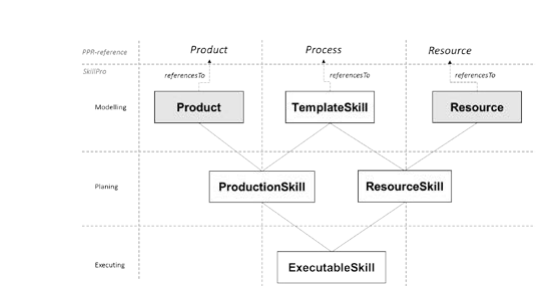
On the modelling level, resources keep their original meaning and are modelled as is in established AutomationML examples within the AutomationML IEC standard series.
Examples for resources are machines or robots. They are assumed to have a representation in an OPC UA namespace to provide data and services and can request these from others.
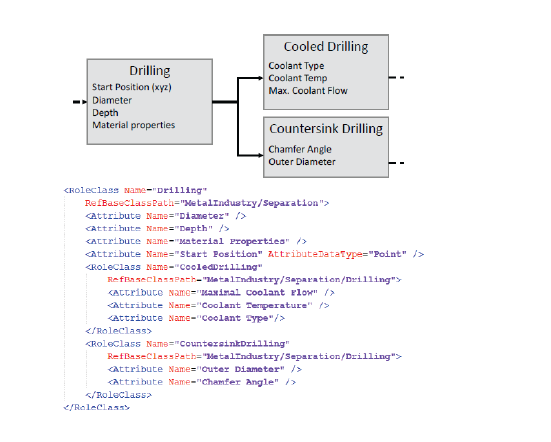
Processes can be manufacturing, logistics, or other production related process. They can be classified in a hierarchical way. One possible hierarchical definition of a drilling process is depicted in Figure 4.
Skills are the generic implementation of a process for a specific resource, this means that they indicate the ability of the resource to execute the process under the constraints described in the attributes.
Products should be modelled as InternalElements. The ID of the product can be modelled via the attribute ID of the InternalElement. Products should assign the RoleClass SkillProRoleClassLib/SkillProProduct (either via RoleRequirement or SupportedRoleClass). The SkillPro product role defines the attribute ProductTypeID and the ExternalInterface ProductionSkillInterface, an interface to be linked to ProductionSkills.
The original processes in AutomationML are referred to as TemplateSkills. These TemplateSkills are a generic description of process types.
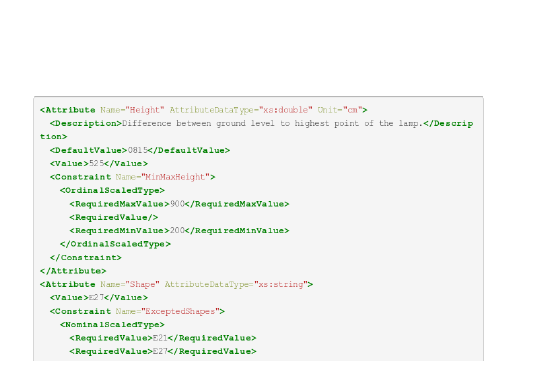
Several skills define parameters, their values or their value constraints. The AutomationML Attribute fulfils all these requirements. An example is depicted in Figure 6.
ProductionSkill corresponds to a product requirement regarding a transformation step during production (product1 becomes product2). It is therefore linked to one or several input and output products and references one TemplateSkill, the production process that is involved in the transformation. Thus, ProductionSkills should be modelled as InternalElements and should assign the RoleClass SkillProRoleClassLib/ProductionSkill and the needed TemplateSkill role class. While it is necessary to connect ProductionSkills to the products, a new InterfaceClass SkillProInterfaceClassLib/ProductionSkillConnector is introduced. ProductionSkills and Products should possess ExternalInterfaces derived from this type which can then be connected.
ResourceSkill is the realisation of a TemplateSkill by a Resource. It defines the ability of a resource to perform a process (described by a TemplateSkill). It furthermore provides value ranges or restrictions for the metadata to be described in the implemented TemplateSkill.
An ExecutableSkill is the match of a ProductionSkill and a ResourceSkill. They are modelled as InternalElements and should assign the RoleClass SkillProRoleClassLib/ExecutableSkill. ExecutableSkills includes a reference to the responsible SEE and an estimated duration for execution.
4. Conclusion and Outlook
The SkillPro project aims at more flexible production systems in the sense of plug & produce to achieve and support efficient production changes. Therefore production modelling, planning, and execution shall be based on existing standards such as AutomationML and OPC UA. Each component (either hardware or software) must therefore be able to describe itself and its skills and capabilities and provide this self-description to other partners within the production system. To this end it has to be equipped with a communicating unit to distribute the information and to get information from others.
The base for plug & work for flexible production systems is provided. The approach developed in the SkillPro project has been validated at the project’s midterm in a prototype implementation. However for an industry-ready solution many details remain to be solved.
Acknowledgments
This work has been partially funded by the European Commission through the SkillPro project (Grant agreement ICT-287733). The authors would like to thank the SkillPro partners for the intensive exchange and collaboration.
References
[1] EU project SkillPro, “Skill-based Propagation of Plug&Produce-Devices in Reconfigurable Production Systems by AML”, 2014.
[2] J. Pfrommer, M. Schleipen, T. Usländer, U. Epple, R. Heidel, L. Urbas, O. Sauer, J. Beyerer, “Begrifflichkeiten um Industrie 4.0 – Ordnung im Sprachwirrwarr”, in: Jumar, U.; Diedrich, C.: 13. Fachtagung EKA Entwurf komplexer Automatisierungssysteme, 14./15.05.2014, Magdeburg, Otto-von-Guericke-Universität Magdeburg/ifak, 2014.
[3] R. Drath, A. Lüder, J. Peschke, and L. Hundt, “AutomationML – the glue for seamless automation engineering,” in IEEE International Conference on Emerging Technologies and Factory Automation, ETFA 2008, 2008, pp. 616–623.
[4] IEC 62541, OPC Unified Architecture (OPC UA), standard series, 2010–2012.
[5] M. Schleipen, “Adaptivität und semantische Interoperabilität für Manufacturing Execution Systeme (MES)”, Karlsruher Schriften zur Anthropomatik, ISBN 978-3-86644-955-8, 2013.
[6] J. Pfrommer, D. Stogl, K. Aleksandrov, V. Schubert, B. Hein, “Modelling and Orchestration of Service-Based Manufacturing Systems via Skills”, in: Emerging Technologies & Factory Automation (ETFA), 2014 IEEE 19th Conference on, September 2014.
[7] R. Henßen, M. Schleipen, “Interoperability between OPC-UA and AutomationML”, Disruptive Innovation in Manufacturing Engineering towards the 4th Industrial Revolution, Proceedings of the 8th International CIRP Conference on Digital Enterprise Technology – DET 2014, Stuttgart, Fraunhofer Verlag, ISBN 978-3-8396-0697-1, 2014.
[8] M. Schleipen and R. Drath, “Three-View-Concept for modeling process or manufacturing plants with AutomationML,” in Emerging Technologies & Factory Automation, ETFA 2009, IEEE Conference on, 2009, pp. 1–4.
[9] IEC 62714, Engineering data exchange format for use in industrial automation systems engineering – Automation markup language (AutomationML), standard series, 2014.
[10] A. Björkelund, J. Malec, K. Nilsson, and P. Nugues, “Knowledge and skill representations for robotized production,” in Proceedings of the 18th IFAC Congress, Milano, 2011.
BibTeX
@inproceedings{schleipen2014skills,
  author    = {Schleipen, Miriam and Hein, Bj{\"o}rn and Pfrommer, Julius and Aleksandrov, Kiril and Stogl, Denis and Escaida Navarro, Stefan and Beyerer, J{\"u}rgen},
  title     = {{AutomationML} to describe skills of production plants based on the {PPR} concept},
  booktitle = {Proceedings of the 3rd AutomationML User Conference},
  address   = {Blomberg, Germany},
  month     = oct,
  year      = {2014},
  publisher = {AutomationML e.V.},
  url       = {https://www.automationml.org/conferences/conference-highlights/automationml-to-describe-skills-of-production-plants-based-on-the-ppr-concept/}
}
How to Cite
M. Schleipen, B. Hein, J. Pfrommer, K. Aleksandrov, D. Stogl, S. Escaida Navarro, J. Beyerer: “AutomationML to describe skills of production plants based on the PPR concept”, Proceedings of the 3rd AutomationML User Conference, Blomberg, Germany, 7–8 October 2014.
This page is a text rendering of the original conference paper, published for accessibility and search. The PDF is the authoritative version. Figures 1 and 3 are available in the PDF. If you are an author and would like a correction, please contact office@automationml.org.