
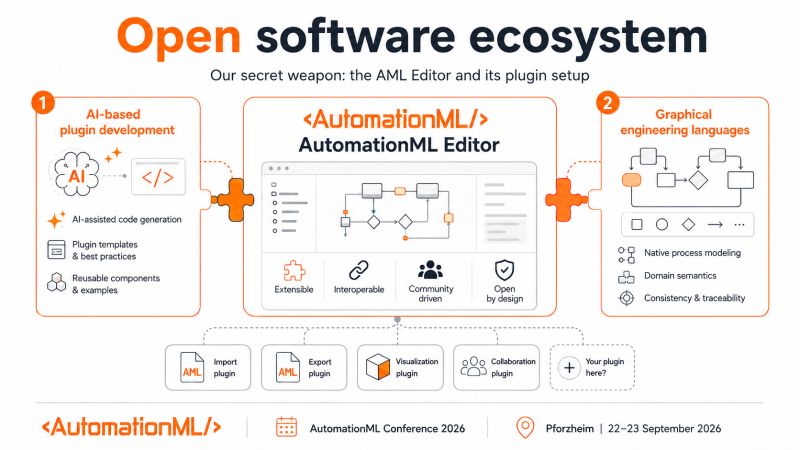
A standard is more than its file format. If AutomationML wants to connect engineering domains, we also need an open software ecosystem around the standard: a place where new ideas can be implemented, tested and made usable without having to build an entirely new engineering tool every time.
That is where the AutomationML Editor and its plugin architecture become particularly interesting. At the AutomationML Conference 2026, two contributions show where this can lead.
AI based plugin development for the AutomationML Editor
Rainer Drath, Hochschule Pforzheim
The contribution explores how AI-assisted development can dramatically lower the barrier for creating new AutomationML Editor plugins, enabling domain experts to turn engineering ideas into working tooling much faster.
Bringing Graphical Engineering Languages to AutomationML
Hamied Nabizada, Helmut-Schmidt-Universität / Universität der Bundeswehr Hamburg
The contribution demonstrates how graphical process modelling according to VDI/VDE 3682 can be integrated directly into the AutomationML Editor, while AutomationML remains the common underlying engineering model.
For us, these are more than two new plugins. They point towards an important direction for AutomationML: the standard defines how engineering information can be exchanged, but the surrounding software architecture determines how easily people can actually work with it, extend it and build new applications on top of it.
That open and extensible tooling ecosystem will therefore be an important part of our discussions on the future of AutomationML.
All accepted contributions for the AutomationML Conference 2026 are published individually on the Conference Highlights page.